

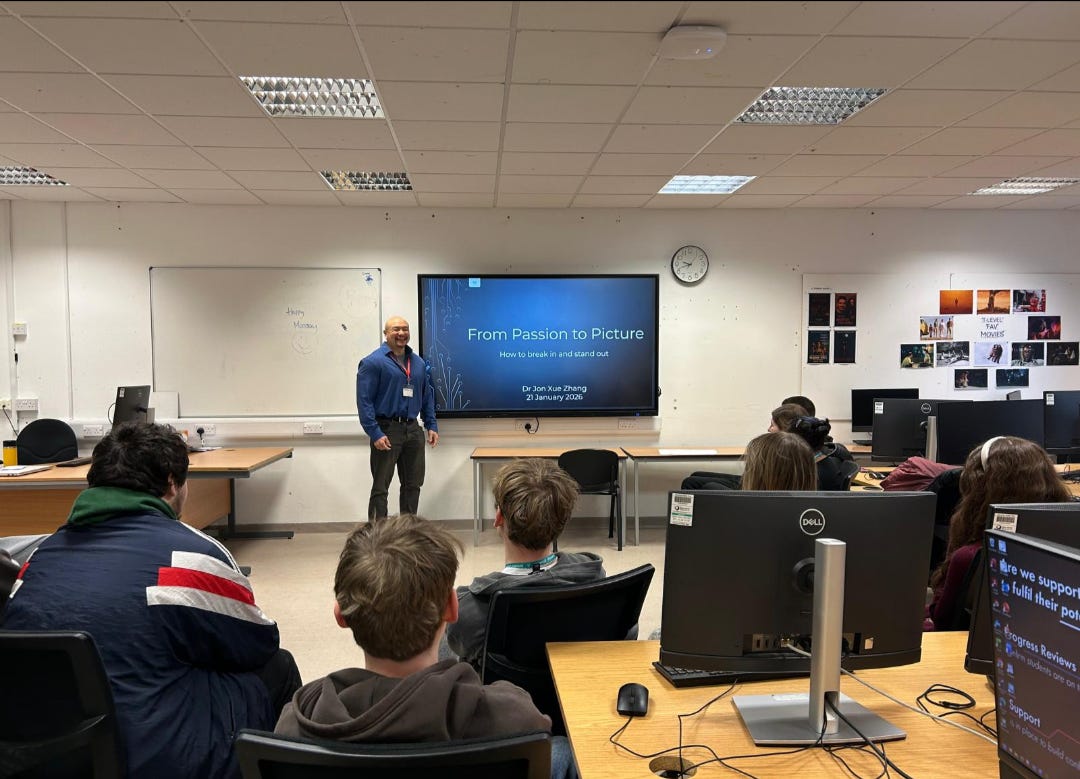
This is based lecture slides I wrote specifically for Media students who are trying to get their foot in the door.
There is no single route into the film and media industry. Ask ten people working in film how they got their first opportunity and you may well get ten completely different answers. Some studied film or media at university, whereas others started making videos with friends. Some got work experience at a production company, whereas others volunteered, knew somebody who knew somebody, or simply sent an email at exactly the right moment.
That uncertainty can make starting a career in the industry feel daunting, so we’ll go through some things in this article to help make things seem more manageable.
You don’t need to wait for somebody to give you permission to begin
Whether you want to work in directing, cinematography, editing, sound, production, animation, design, writing or another role behind the camera, there are things you can be doing now to improve your skills, build your body of work and give people a reason to hire you.
Don’t Wait for work to start working
One of the most useful things you can do at the beginning of your career is to create things
Start a YouTube channel, make short films, animations, design posters, even record a podcast, or experiment with different styles, genres and formats on social media.
Keep in mind that your early work doesn’t have to be brilliant. In fact, it probably won’t be. That’s part of the process; if you’re constantly working and progressing, looking back at your early work can often show you just how far you’ve come.
Creating regularly gives you an opportunity to experiment without the pressure of a professional production. You discover what you’re good at, what you enjoy and where the gaps in your knowledge are, which is your responsibility to patch.
I can’t state enough the importance of building a portfolio and providing that evidence of your interest as opposed to just declaring it; there is a real difference between saying that you want to be an editor and saying that you want to be an editor, whilst then proceeding to show the last few things you’ve edited.
Of course, your online presence can become part of that evidence too. Posting work and documenting your progress gives somebody the opportunity to see what you’re capable of before you’ve ever met them (I know so many people who got work because of their body of work, so you never know who may stumble upon your channels. I can attest to this from a personal perspective too). It’s also important to learn how different platforms work, specifically metrics and insights, which can teach you something about your audience and how people respond to your content.
I’ve often stated in interviews that when you’re not working in your craft, work on your craft. This doesn’t mean every waking hour needs to become productive, it means you don’t have to wait until somebody is paying you before you start becoming better at what you want to do. Put in the work now because you never rise to the occasion; you fall to the level of your training.
If you’re studying film, media or a related subject, your course gives you an environment in which to learn, but don’t allow your course to become the boundary of your experience. It’s important to get out of the classroom and make and do things.
Find the people around you who are equally enthusiastic and make something together. If somebody needs help with their short film, offer it. If somebody is putting together a shoot at the weekend, ask if they need another pair of hands. Not every project needs to be your project; helping somebody else can give you practical experience, another credit and perhaps most importantly, another relationship. Additionally, you may have to wear lots of different hats, which not only gives you experience in another skillset, but also the ability to handle yourself under pressure, whilst juggling multiple things at once.
In addition to social media, film festivals, competitions and online challenges can provide deadlines and motivation as well as opportunities for your work to be seen. Selection, recognition or an award can strengthen a portfolio, but even entering can teach you something about presenting your work professionally. At the same time, keep your portfolio up to date.
Networking
The film industry is intensely collaborative. A production involves people with different skills solving hundreds of problems together, often under significant time pressure. Learning how to work with other people is therefore not something separate from learning your craft. It’s part of your craft.
Look beyond your immediate circle as well; join filmmaking groups, online communities and local media organisations, volunteer at events or festivals and get involved with other students. Every project puts you around more people and every person potentially introduces you to another project. This is how a network begins.
Of course, networking is essential, but it doesn’t always mean walking into a room full of strangers and desperately trying to impress them. Instead, networking is really about building professional relationships. I would advise attending workshops, screenings, festivals and industry talks, where you can speak to people and ask them about what they do. You can also connect with your peers as well as people who are already established.
You never know, but your classmate today could be a producer, director, editor or cinematographer recommending you for a job five years from now.
One thing I would emphasise is not to approach every interaction by immediately asking what they can do for you. Instead, take an interest in them; help where you can, stay in contact, support other people’s projects, most importantly, be somebody people enjoy working with.
You will have heard the saying, ‘it’s not what you know, but who you know’, but it’s also who knows you; when somebody needs a crew member, they are unlikely to conduct an exhaustive search of every talented person in the country. Instead, they ask ‘who do we know?’
I would also advise proactively reaching out, especially if you have a body of work behind you. Research production companies, agencies, post-production houses, studios and professionals doing the kind of work that interests you.
You don’t necessarily have to ask for employment either; opportunities could include:
Shadowing someone for a period of time
Asking for advice
Any work placements or internships available
The worst outcome of many of these emails is simply that you don’t receive a reply, which can be disappointing, but it doesn’t leave you any worse off than you were before sending it.
Bear in mind that you don’t need to be looking at companies within the film industry to get opportunities; a lot of businesses will have a marketing department, where your skills may be directly relevant to the media they produce, where you can learn and gain more invaluable experience.